Urban Tree Threats for Arizona and New Mexico
  • Home
  • Threats Directory
  • Threats Guide
  • Integrated Pest Management
  • Environmental Threats
  • Informational Handout

​URBAN TREE THREATS DUE TO ENVIRONMENTAL CONDITIONS AND POOR CULTURAL PRACTICES

Detrimental environmental conditions and poor cultural practices can result in urban tree damage or death. Learn more about five major environmental conditions and cultural practices that affect urban trees and recommended strategies to improve tree health:
  • Injuries
  • Planting
  • Water Supply
  • Selection and Placement​
  • Pruning​
Picture
Picture
CLICK ON THIS IMAGE TO DOWNLOAD A PDF ON INJURIES
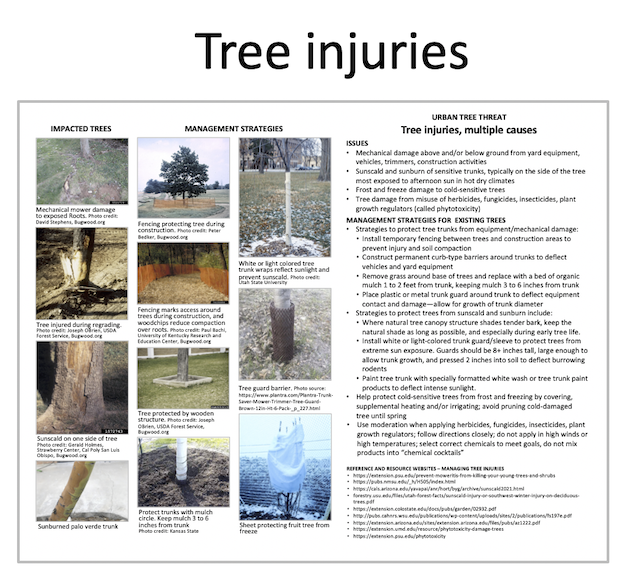
Tree injuries, multiple causes
​ISSUES
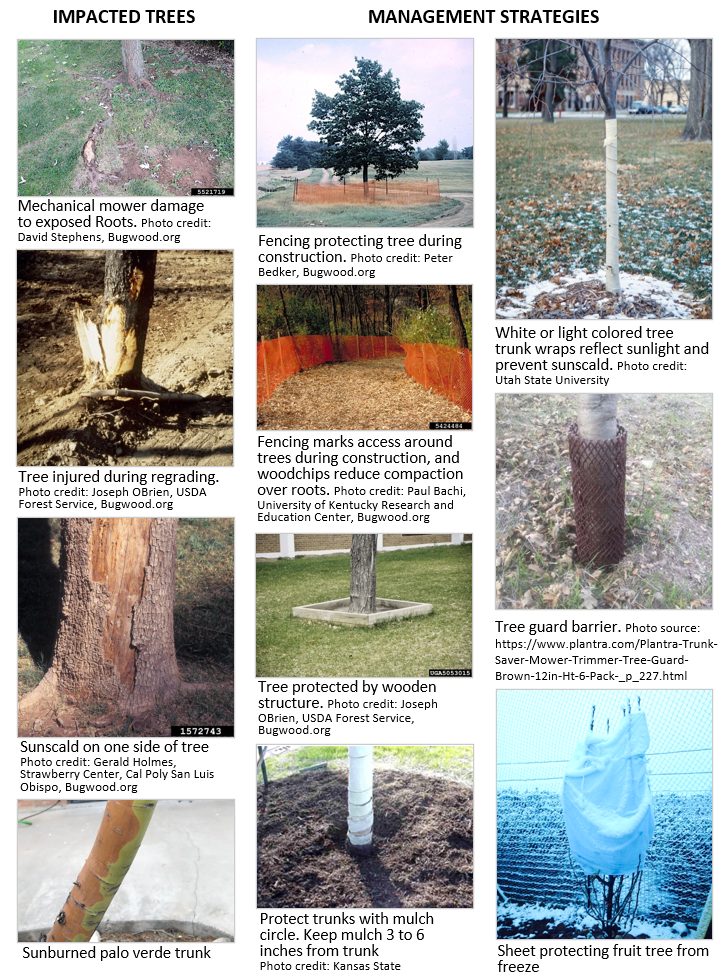
  • Mechanical damage above and/or below ground from yard equipment, vehicles, trimmers, construction activities
  • Sunscald and sunburn of sensitive trunks, typically on the side of the tree most exposed to afternoon sun in hot dry climates
  • Frost and freeze damage to cold-sensitive trees
  • Tree damage from misuse of herbicides, fungicides, insecticides, plant growth regulators (called phytotoxicity)

MANAGEMENT strategies for  EXISTING TREES
Strategies to protect tree trunks from equipment/mechanical damage: 
  • Install temporary fencing between trees and construction areas to prevent injury and soil compaction
  • Construct permanent curb-type barriers around trunks to deflect vehicles and yard equipment
  • Remove grass around base of trees and replace with a bed of organic mulch 1 to 2 feet from trunk, keeping mulch 3 to 6 inches from trunk
  • Place plastic or metal trunk guard around trunk to deflect equipment contact and damage—allow for growth of trunk diameter
​Strategies to protect trees from sunscald and sunburn include:
  • Where natural tree canopy structure shades tender bark, keep the natural shade as long as possible, and especially during early tree life. 
  • Install white or light-colored trunk guard/sleeve to protect trees from extreme sun exposure. Guards should be 8+ inches tall, large enough to allow trunk growth, and pressed 2 inches into soil to deflect burrowing rodents
  • Paint tree trunk with specially formatted white wash or tree trunk paint products to deflect intense sunlight. 
  • Help protect cold-sensitive trees from frost and freezing by covering,
  • supplemental heating and/or irrigating; avoid pruning cold-damaged tree until spring
  • Use moderation when applying herbicides, fungicides, insecticides, plant growth regulators; follow directions closely; do not apply in high winds or high temperatures; select correct chemicals to meet goals, do not mix products into “chemical cocktails”
​REFERENCE AND RESOURCE WEBSITES – MANAGING TREE INJURIES
https://extension.psu.edu/prevent-moweritis-from-killing-your-young-trees-and-shrubs
https://pubs.nmsu.edu/_h/H505/index.html
https://cals.arizona.edu/yavapai/anr/hort/byg/archive/sunscald2021.html
forestry.usu.edu/files/utah-forest-facts/sunscald-injury-or-southwest-winter-injury-on-deciduous-trees.pdf
https://extension.colostate.edu/docs/pubs/garden/02932.pdf
http://pubs.cahnrs.wsu.edu/publications/wp-content/uploads/sites/2/publications/fs197e.pdf
https://extension.arizona.edu/sites/extension.arizona.edu/files/pubs/az1222.pdf
https://extension.umd.edu/resource/phytotoxicity-damage-trees
https://extension.psu.edu/phytotoxicity
Picture
PictureCLICK THIS IMAGE TO DOWNLOAD A PDF ON TREE PLANTING ISSUES

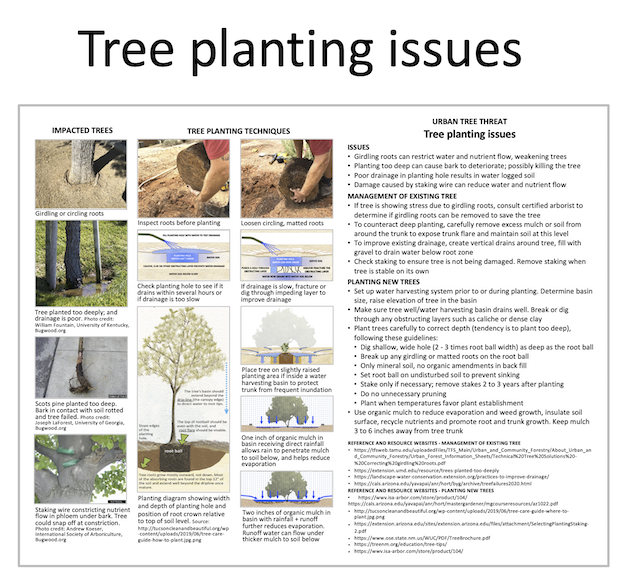
Tree Planting Issues
​ISSUES
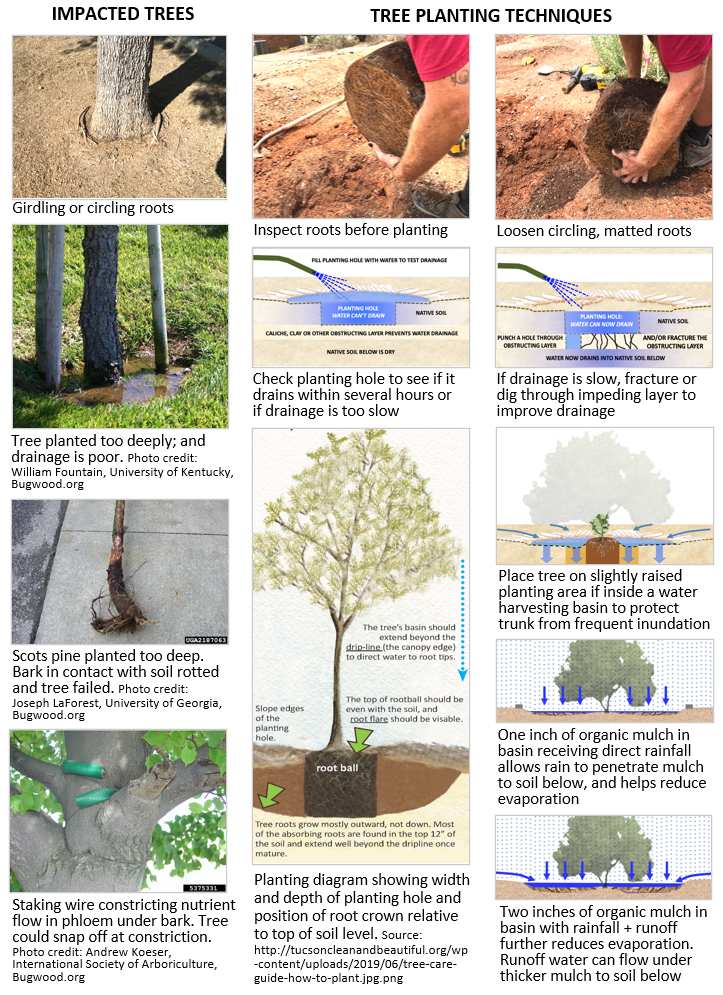
  • Girdling roots can restrict water and nutrient flow, weakening trees
  • Planting too deep can cause bark to deteriorate; possibly killing the tree
  • Poor drainage in planting hole results in water logged soil
  • Damage caused by staking wire can reduce water and nutrient flow

MANAGEMENT OF EXISTING TREE
  • If tree is showing stress due to girdling roots, consult certified arborist to determine if girdling roots can be removed to save the tree
  • To counteract deep planting, carefully remove excess mulch or soil from around the trunk to expose trunk flare and maintain soil at this level
  • To improve existing drainage, create vertical drains around tree, fill with gravel to drain water below root zone
  • Check staking to ensure tree is not being damaged. Remove staking when tree is stable on its own

Planting NEW TREES
  • Set up water harvesting system prior to or during planting. Determine basin size, raise elevation of tree in the basin 
  • Make sure tree well/water harvesting basin drains well. Break or dig through any obstructing layers such as caliche or dense clay
  • Plant trees carefully to correct depth (tendency is to plant too deep), following these guidelines:
  • Dig shallow, wide hole (2 - 3 times root ball width) as deep as the root ball 
  • Break up any girdling or matted roots on the root ball
  • Only mineral soil, no organic amendments in back fill 
  • Set root ball on undisturbed soil to prevent sinking
  • Stake only if necessary; remove stakes 2 to 3 years after planting
  • Do no unnecessary pruning
  • Plant when temperatures favor plant establishment 
  • Use organic mulch to reduce evaporation and weed growth, insulate soil surface, recycle nutrients and promote root and trunk growth. Keep mulch 3 to 6 inches away from tree trunk
​REFERENCE AND RESOURCE WEBSITES - MANAGEMENT OF EXISTING TREE
https://tfsweb.tamu.edu/uploadedFiles/TFS_Main/Urban_and_Community_Forestry/About_Urban_and_Community_Forestry/Urban_Forest_Information_Sheets/Technical%20Tree%20Solutions%20-%20Correcting%20girdling%20roots.pdf
https://extension.umd.edu/resource/trees-planted-too-deeply
https://landscape-water-conservation.extension.org/practices-to-improve-drainage/
https://cals.arizona.edu/yavapai/anr/hort/byg/archive/treefailures2020.html
REFERENCE AND RESOURCE WEBSITES - Planting NEW TREES
https://wwv.isa-arbor.com/store/product/104/ 
https://cals.arizona.edu/yavapai/anr/hort/mastergardener/mgcourseresources/az1022.pdf
http://tucsoncleanandbeautiful.org/wp-content/uploads/2019/06/tree-care-guide-where-to-plant.jpg.png
https://extension.arizona.edu/sites/extension.arizona.edu/files/attachment/SelectingPlantingStaking-2.pdf
https://www.ose.state.nm.us/WUC/PDF/TreeBrochure.pdf
https://treenm.org/education/tree-tips/
https://wwv.isa-arbor.com/store/product/104/ 
Picture
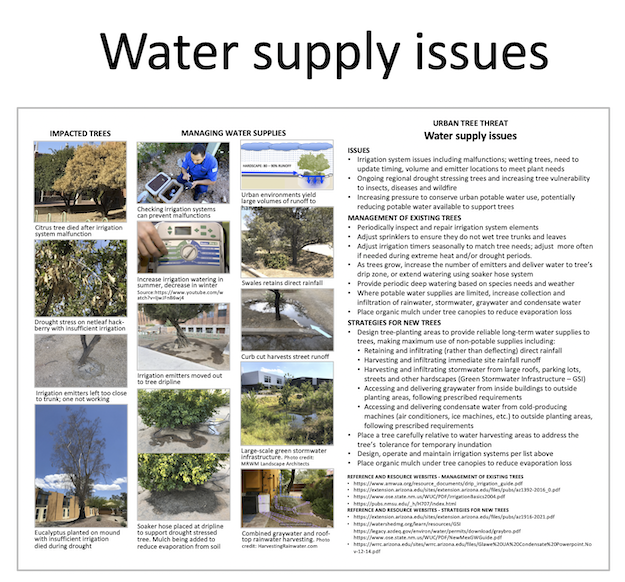
PictureCLICK ON THIS IMAGE TO DOWNLOAD A PDF ON WATER SUPPLY ISSUES

Water Supply Issues
​ISSUES
  • Irrigation system issues including malfunctions; wetting trees, need to update timing, volume and emitter locations to meet plant needs
  • Ongoing regional drought stressing trees and increasing tree vulnerability to insects, diseases and wildfire
  • Increasing pressure to conserve urban potable water use, potentially reducing potable water available to support trees

MANAGEMENT OF EXISTING TREES
  • Periodically inspect and repair irrigation system elements
  • Adjust sprinklers to ensure they do not wet tree trunks and leaves
  • Adjust irrigation timers seasonally to match tree needs; adjust  more often if needed during extreme heat and/or drought periods. 
  • As trees grow, increase the number of emitters and deliver water to tree’s drip zone, or extend watering using soaker hose system
  • Provide periodic deep watering based on species needs and weather
  • Where potable water supplies are limited, increase collection and infiltration of rainwater, stormwater, graywater and condensate water
  • Place organic mulch under tree canopies to reduce evaporation loss

STRATEGIES FOR NEW TREES
  • Design tree-planting areas to provide reliable long-term water supplies to trees, making maximum use of non-potable supplies including:
  • Retaining and infiltrating (rather than deflecting) direct rainfall
  • Harvesting and infiltrating immediate site rainfall runoff
  • Harvesting and infiltrating stormwater from large roofs, parking lots, streets and other hardscapes (Green Stormwater Infrastructure – GSI)
  • Accessing and delivering graywater from inside buildings to outside planting areas, following prescribed requirements
  • Accessing and delivering condensate water from cold-producing machines (air conditioners, ice machines, etc.) to outside planting areas, following prescribed requirements
  • Place a tree carefully relative to water harvesting areas to address the tree’s  tolerance for temporary inundation
  • Design, operate and maintain irrigation systems per list above
  • Place organic mulch under tree canopies to reduce evaporation loss
​REFERENCE AND RESOURCE WEBSITES - MANAGEMENT OF EXISTING TREES
https://www.amwua.org/resource_documents/drip_irrigation_guide.pdf
https://extension.arizona.edu/sites/extension.arizona.edu/files/pubs/az1392-2016_0.pdf
https://www.ose.state.nm.us/WUC/PDF/IrrigationBasics2004.pdf
https://pubs.nmsu.edu/_h/H707/index.html
REFERENCE AND RESOURCE WEBSITES - STRATEGIES FOR NEW TREES
https://extension.arizona.edu/sites/extension.arizona.edu/files/pubs/az1916-2021.pdf
https://watershedmg.org/learn/resources/GSI https://legacy.azdeq.gov/environ/water/permits/download/graybro.pdf https://www.ose.state.nm.us/WUC/PDF/NewMexGWGuide.pdf
https://wrrc.arizona.edu/sites/wrrc.arizona.edu/files/Glawe%20UA%20Condensate%20Powerpoint.Nov-12-14.pdf
Picture
Picture
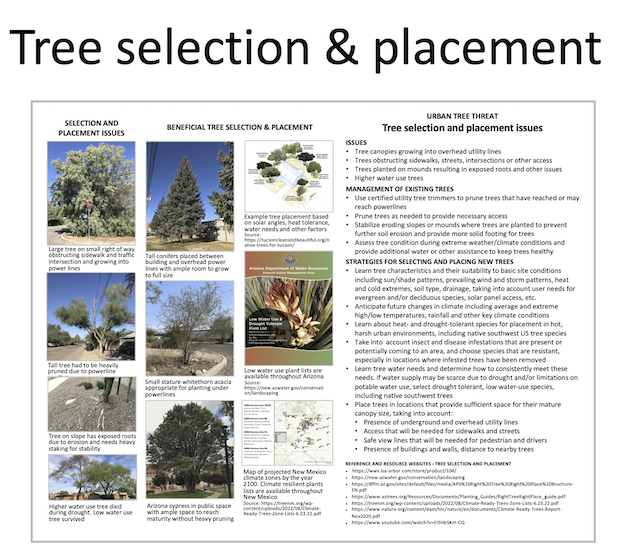
CLICK ON THIS IMAGE TO DOWNLOAD A PDF ON TREE SELECTION AND PLACEMENT ISSUES
Tree Selection and Placement Issues
​ISSUES
  • Tree canopies growing into overhead utility lines
  • Trees obstructing sidewalks, streets, intersections or other access
  • Trees planted on mounds resulting in exposed roots and other issues
  • Higher water use trees 

MANAGEMENT OF EXISTING TREES
  • Use certified utility tree trimmers to prune trees that have reached or may reach powerlines
  • Prune trees as needed to provide necessary access
  • Stabilize eroding slopes or mounds where trees are planted to prevent further soil erosion and provide more solid footing for trees
  • Assess tree condition during extreme weather/climate conditions and provide additional water or other assistance to keep trees healthy

STRATEGIES FOR SELECTING AND PLACING NEW TREES
  • Learn tree characteristics and their suitability to basic site conditions including sun/shade patterns, prevailing wind and storm patterns, heat and cold extremes, soil type, drainage, taking into account user needs for evergreen and/or deciduous species, solar panel access, etc.
  • Anticipate future changes in climate including average and extreme high/low temperatures, rainfall and other key climate conditions 
  • Learn about heat- and drought-tolerant species for placement in hot, harsh urban environments, including native southwest US tree species
  • Take into  account insect and disease infestations that are present or potentially coming to an area, and choose species that are resistant, especially in locations where infested trees have been removed
  • Learn tree water needs and determine how to consistently meet these needs. If water supply may be scarce due to drought and/or limitations on potable water use, select drought tolerant, low water-use species, including native southwest trees
  • Place trees in locations that provide sufficient space for their mature canopy size, taking into account:
  • Presence of underground and overhead utility lines
  • Access that will be needed for sidewalks and streets
  • Safe view lines that will be needed for pedestrian and drivers
  • Presence of buildings and walls, distance to nearby trees
​REFERENCE AND RESOURCE WEBSITES - TREE SELECTION AND PLACEMENT 
https://wwv.isa-arbor.com/store/product/104/ 
https://new.azwater.gov/conservation/landscaping
https://dffm.az.gov/sites/default/files/media/APS%20Right%20Tree%20Right%20Place%20Brochure-EN.pdf
https://www.aztrees.org/Resources/Documents/Planting_Guides/RightTreeRightPlace_guide.pdf
https://treenm.org/wp-content/uploads/2022/08/Climate-Ready-Trees-Zone-Lists-6.23.22.pdf
https://www.nature.org/content/dam/tnc/nature/en/documents/Climate-Ready-Trees-Report-Nov2020.pdf
https://www.youtube.com/watch?v=EI5HbSKm-CQ
Picture
Picture
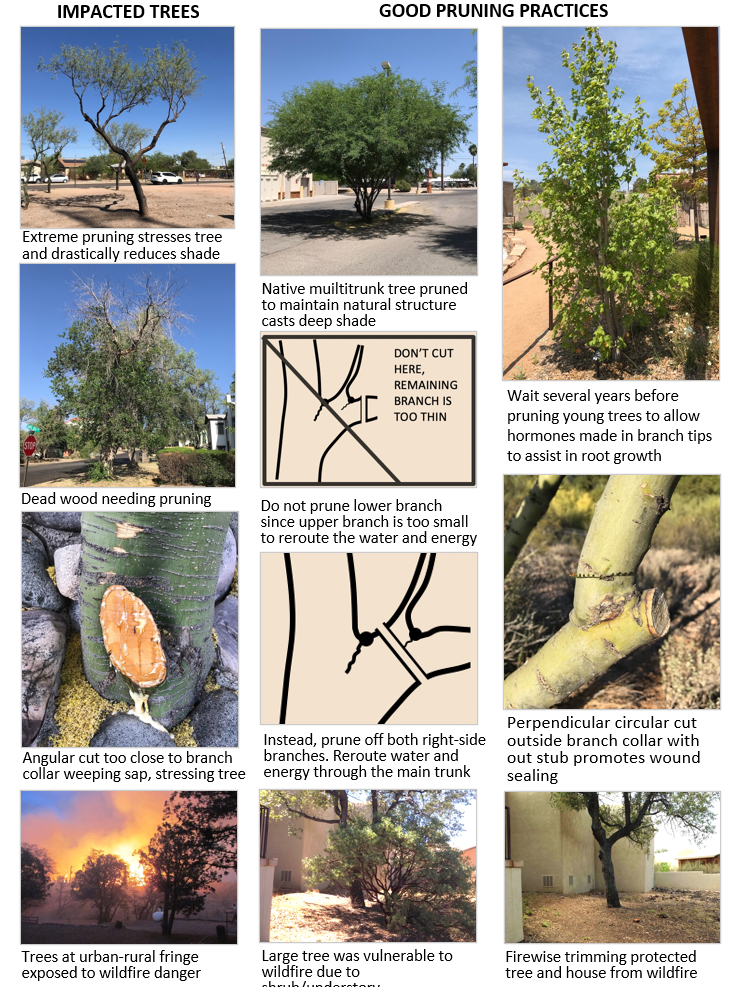
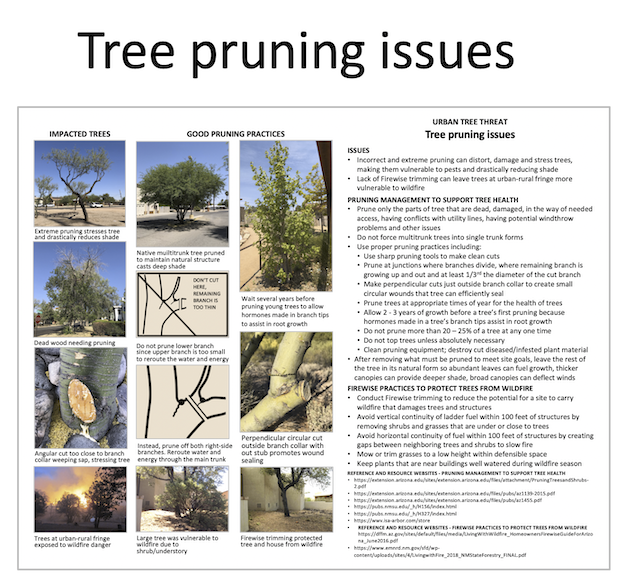
CLICK ON THIS IMAGE TO DOWNLOAD A PDF ON PRUNING ISSUES
Tree Pruning Issues
​ISSUES
  • Incorrect and extreme pruning can distort, damage and stress trees, making them vulnerable to pests and drastically reducing shade
  • Lack of Firewise trimming can leave trees at urban-rural fringe more vulnerable to wildfire

Pruning MANAGEMENT to support tree health
  • Prune only the parts of tree that are dead, damaged, in the way of needed access, having conflicts with utility lines, having potential windthrow problems and other issues
  • Do not force multitrunk trees into single trunk forms
  • Use proper pruning practices including:
  • Use sharp pruning tools to make clean cuts
  • Prune at junctions where branches divide, where remaining branch is growing up and out and at least 1/3rd the diameter of the cut branch
  • Make perpendicular cuts just outside branch collar to create small circular wounds that tree can efficiently seal
  • Prune trees at appropriate times of year for the health of trees
  • Allow 2 - 3 years of growth before a tree’s first pruning because hormones made in a tree’s branch tips assist in root growth
  • Do not prune more than 20 – 25% of a tree at any one time
  • Do not top trees unless absolutely necessary
  • Clean pruning equipment; destroy cut diseased/infested plant material
  • After removing what must be pruned to meet site goals, leave the rest of the tree in its natural form so abundant leaves can fuel growth, thicker canopies can provide deeper shade, broad canopies can deflect winds

FIREWISE PRACTICES TO PROTECT TREES FROM WILDFIRE
  • Conduct Firewise trimming to reduce the potential for a site to carry wildfire that damages trees and structures
  • Avoid vertical continuity of ladder fuel within 100 feet of structures by removing shrubs and grasses that are under or close to trees
  • Avoid horizontal continuity of fuel within 100 feet of structures by creating gaps between neighboring trees and shrubs to slow fire
  • Mow or trim grasses to a low height within defensible space
  • Keep plants that are near buildings well watered during wildfire season
​REFERENCE AND RESOURCE WEBSITES - Pruning MANAGEMENT to support tree health
https://extension.arizona.edu/sites/extension.arizona.edu/files/attachment/PruningTreesandShrubs-2.pdf
https://extension.arizona.edu/sites/extension.arizona.edu/files/pubs/az1139-2015.pdf
https://extension.arizona.edu/sites/extension.arizona.edu/files/pubs/az1455.pdf
https://pubs.nmsu.edu/_h/H156/index.html
https://pubs.nmsu.edu/_h/H327/index.html
https://wwv.isa-arbor.com/store
REFERENCE AND RESOURCE WEBSITES - FIREWISE PRACTICES TO PROTECT TREES FROM WILDFIRE https://dffm.az.gov/sites/default/files/media/LivingWithWildfire_HomeownersFirewiseGuideForArizona_June2016.pdf
https://www.emnrd.nm.gov/sfd/wp-content/uploads/sites/4/LivingwithFire_2018_NMStateForestry_FINAL.pdf
Website and directory database designed and maintained by the Arizona Community Tree Council, Inc.

Contact Us

​602-354-3023    |    [email protected]
​
​
  • Home
  • Threats Directory
  • Threats Guide
  • Integrated Pest Management
  • Environmental Threats
  • Informational Handout